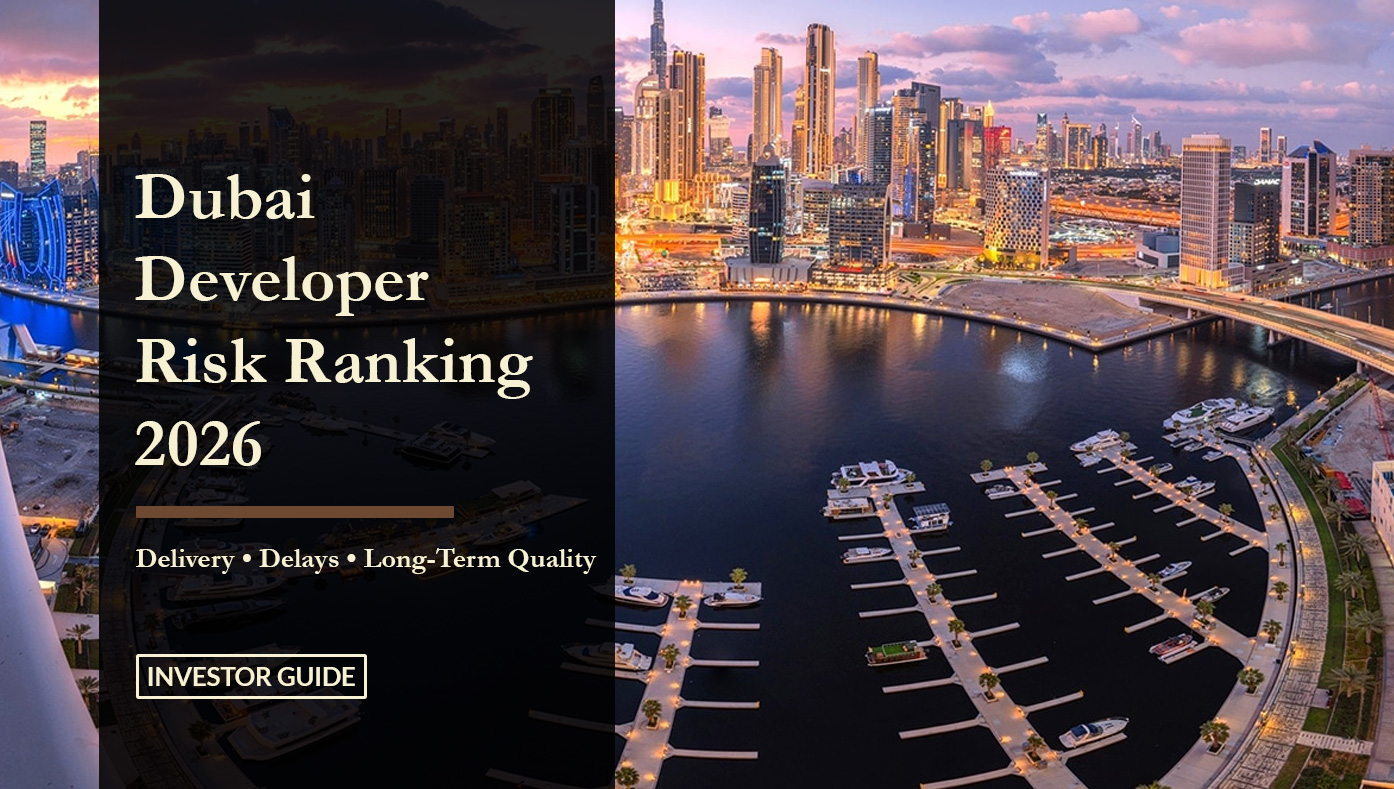
Dubai Developer Risk Ranking 2026: How Buyers Assess Delivery, Delays & Long-Term Quality
In Dubai real estate, the property you buy matters — but the developer behind it matters more.
Between 2026 and the next cycle, developer selection will quietly separate investors who compound wealth from those who absorb avoidable risk.
Dubai is a developer-led market. Inventory, pricing power, construction timelines, community quality, and resale confidence all originate from the developer level. Yet many buyers still choose projects based on brochures, launch hype, or payment plans — not delivery risk.
This guide explains how serious buyers and investors evaluate Dubai real estate developers, how developer risk actually shows up over time, and how to rank developers logically — not emotionally.
For broader market grounding, explore:
Why Developer Risk Is the Most Underestimated Factor in Dubai
Dubai’s growth has been powered by ambitious developers — but ambition alone does not guarantee investor safety.
Developer risk influences:
- Project delivery timelines
- Construction quality and finishing standards
- Service charge sustainability
- Tenant and buyer confidence
- Long-term resale liquidity
Investors who ignore developer risk often discover problems only after handover — when capital is already locked.
Experienced investors assess the developer before the unit.
How Professional Investors Rank Dubai Developers
There is no official “developer risk score” published by authorities.
Instead, experienced buyers evaluate developers across multiple dimensions that compound over time.
The most reliable ranking framework includes:
1) Delivery Track Record Across Cycles
One successful project is not proof of reliability.
Professional investors examine:
- How many projects were delivered on time
- Performance during slower market periods
- Consistency across different communities
Developers that deliver across multiple market cycles demonstrate operational depth — not just momentum.
Investor research often begins with:
2) Financial Strength and Capital Structure
Strong branding does not always mean strong balance sheets.
Investors look for developers with:
- Low dependency on off-plan cash flow
- Diversified revenue streams
- Access to institutional financing
Financially resilient developers are far less likely to delay projects, reduce specifications, or cut corners.
3) Construction Quality and Post-Handover Performance
Delivery does not end at handover.
High-quality developers maintain:
- Durable materials and finishes
- Efficient building systems
- Responsive post-handover maintenance
Poor construction quality shows up later through rising service charges, tenant dissatisfaction, and resale resistance.
4) Service Charge Discipline
Service charges are where developer decisions quietly affect investor returns.
Experienced buyers analyse:
- Operational efficiency of past communities
- Long-term maintenance planning
- Transparency in cost breakdowns
Developers who over-design amenities without long-term cost control often produce assets that underperform net yield.
5) Community Planning vs Isolated Projects
Developers who plan integrated communities outperform those who launch isolated towers.
Master-planned developments create:
- Sustained tenant demand
- Stronger resale ecosystems
- Long-term lifestyle appeal
This distinction becomes critical five to ten years post-handover.
Tier-Based Developer Risk Framework (Investor Lens)
Rather than naming a single “best developer”, professional investors think in tiers.
Tier 1: Institutional-Grade Developers
- Multi-cycle delivery consistency
- Strong balance sheets
- Integrated master planning
- High resale confidence
Often preferred for core portfolio assets.
Tier 2: Growth-Oriented Developers
- Strong recent performance
- Selective project execution
- Moderate risk-reward balance
Used for growth exposure with discipline.
Tier 3: Opportunistic Developers
- Limited track record
- Aggressive pricing or incentives
- Higher dependency on off-plan cash flow
Only suitable with strict risk controls.
Off-Plan Buyers: Where Developer Risk Is Magnified
Off-plan investments amplify developer risk because buyers commit capital before delivery.
Experienced off-plan investors assess:
- Escrow account discipline
- Construction milestone realism
- Past launch-to-handover timelines
- Rental demand at expected completion
Structured guidance:
Why Awards and Recognition Matter — Carefully
Developer awards can be meaningful — but only when understood correctly.
Credible awards often signal:
- Delivery volume consistency
- Developer-broker trust
- Launch execution strength
They should support analysis — not replace it.
Buyers often cross-check:
International Buyers and Developer Risk
Overseas investors face amplified risk due to distance and limited on-ground visibility.
International buyers prioritise developers with:
- Clear legal documentation
- Proven escrow discipline
- Transparent communication
Country-specific insight:
FAQs – Frequently Asked Questions
Is buying from a Tier 1 developer always safer?
Generally yes, but pricing and timing still matter.
Are delays common in Dubai?
They occur, but are far less frequent with financially strong developers.
Can smaller developers still be good investments?
Yes — when risk is priced correctly and exposure is limited.
Wrapping Up
Dubai does not punish risk — it punishes unpriced risk.
Developer selection is not about reputation alone. It is about delivery behaviour, financial resilience, and long-term asset stewardship.
Strong developers compound investor confidence long after handover.
If you want durability — not just upside — developer selection must be deliberate.
Work with advisors who evaluate developers objectively, not emotionally.
In Dubai, the developer you trust defines the asset you hold.