Dubai Mortgage Guide for Foreign Investors (2026): LTV, Bank Financing & Smart Leverage Strategy

How Global Investors Finance Property in Dubai — And Why Structure Matters More Than Interest Rates
When international buyers research buy property in Dubai, the first assumption is often that transactions are cash-based. While Dubai attracts a significant number of cash investors, the reality in 2026 is more strategic. Sophisticated investors — particularly from the UK, GCC, and Europe — use structured mortgage financing to optimize capital allocation, preserve liquidity, and scale portfolios intelligently. Understanding how Dubai mortgage financing works is not about borrowing for necessity; it is about leveraging responsibly to improve return on equity.
Dubai’s property ecosystem is regulated, transparent, and internationally competitive. Combined with clear foreign ownership laws outlined under Dubai real estate regulations for foreign investors, financing structures allow non-residents to enter the market confidently. If you are evaluating whether financing supports your strategy, this guide will help you calculate risk, yield, and long-term positioning — not just monthly payments.
Can Foreign Investors Get a Mortgage in Dubai?
Yes. Non-resident foreign nationals can obtain property financing in Dubai provided they purchase within approved freehold areas. The UAE banking system allows international investors to apply for mortgages subject to income verification, risk profiling, and loan-to-value limits. This financing flexibility is one of the reasons global buyers continue to explore investing in Dubai real estate as part of broader diversification strategies.
However, eligibility and leverage differ between residents and non-residents, and understanding those differences early prevents structuring mistakes later.
Understanding LTV (Loan-to-Value) in Dubai
Loan-to-Value (LTV) determines the percentage of the property price that a bank is willing to finance. It directly impacts your required down payment and therefore your capital deployment strategy.
For UAE residents, banks may finance up to 80% of the property value (for properties under AED 5 million). For non-resident foreign investors, the LTV typically ranges between 50% and 60%. This means international buyers must prepare for higher equity contribution compared to residents.
For example, on a AED 2,000,000 property at 60% LTV, the bank finances AED 1,200,000 and the investor contributes AED 800,000 plus transaction costs. If you haven’t reviewed those cost structures yet, it’s important to align financing decisions with the complete Dubai property transaction cost breakdown to calculate true entry capital.
Interest Rates in Dubai (2026 Overview)
Mortgage interest rates in Dubai are influenced by UAE Central Bank policies and the Emirates Interbank Offered Rate (EIBOR). In 2026, typical mortgage rates range between approximately 3.99% and 5.5%, depending on the bank, applicant profile, and fixed versus variable structure.
Investors should avoid focusing solely on headline rates. The true financing cost includes processing fees, mortgage registration (0.25% of loan amount), valuation fees, and insurance. These components must be included in ROI modeling, especially for yield-focused buyers evaluating Dubai rental income potential.
Fixed vs Variable Mortgage: Which Is Smarter for Investors?
Fixed-rate mortgages lock interest for a defined period, usually between one and five years. This provides predictable cash flow — particularly useful if you are structuring long-term leasing strategies. Variable-rate mortgages fluctuate with EIBOR and may initially appear cheaper, but they introduce exposure to interest rate movements.
For investors prioritizing rental yield stability, fixed rates often provide more reliable income forecasting. Those pursuing shorter holding periods or appreciation-driven strategies may tolerate variable structures. Your decision should align with the broader strategy outlined in your Dubai property buying plan.
Mortgage Approval Process for Foreign Investors
The mortgage approval process in Dubai is structured and documentation-driven. International buyers are typically required to submit passport copies, bank statements, proof of income, and credit profile documentation. Approval timelines generally range from two to four weeks depending on the bank and completeness of documentation.
Pre-approval is highly recommended before finalizing property selection. This ensures your purchasing capacity is confirmed and protects negotiation leverage — particularly when competing in high-demand communities identified within the top areas to invest in Dubai.
Financing Off-Plan Property in Dubai
Off-plan financing operates differently from ready property mortgages. Developers often provide structured payment plans reducing immediate bank dependency. In many cases, mortgage financing becomes relevant closer to project completion. Understanding developer payment schedules is critical before committing to staged investments, especially when following guidance from the Off-Plan Investment Dubai Guide.
Investors combining developer plans with bank financing must align handover timing, valuation expectations, and loan approval windows carefully.
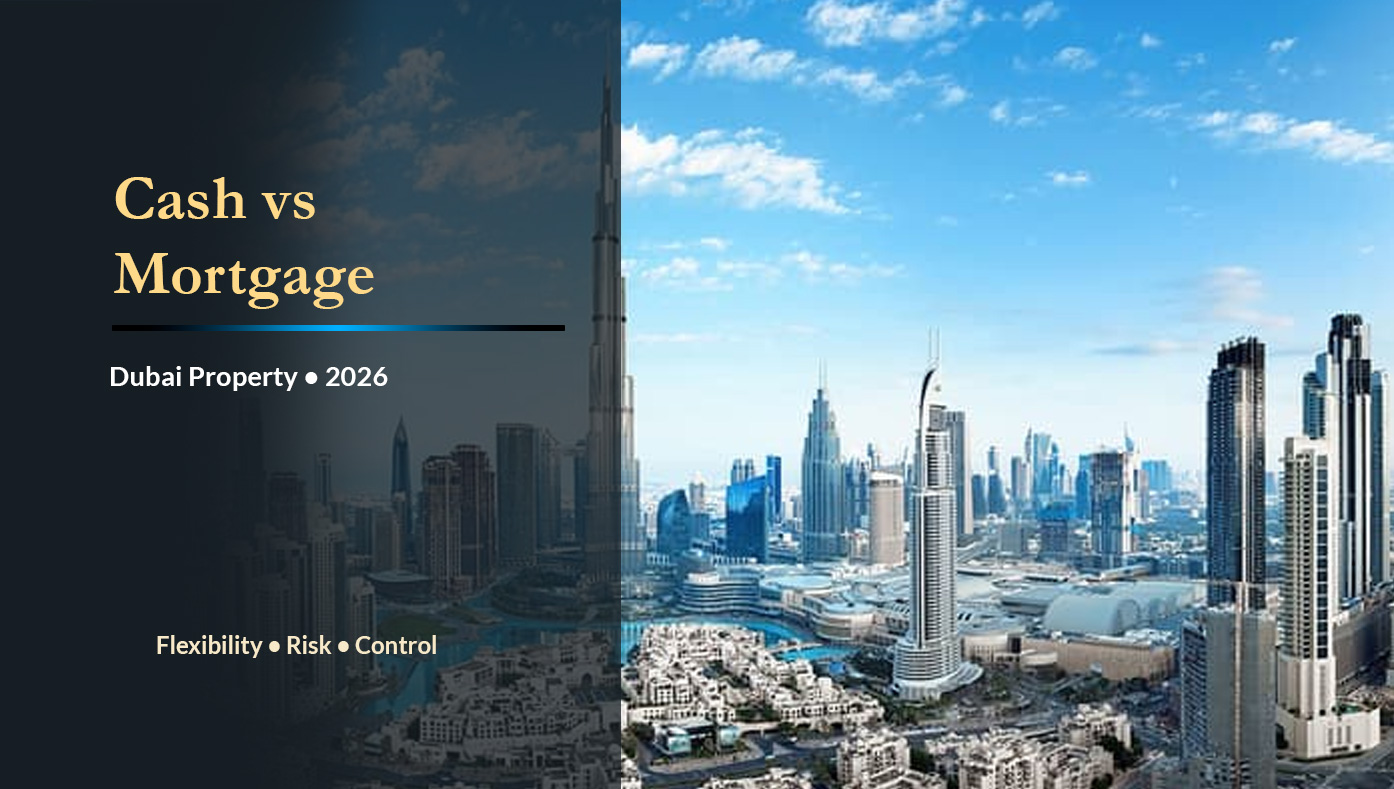
Cash vs Mortgage: Which Approach Is More Strategic in 2026?
Cash buyers benefit from faster transactions and stronger negotiation leverage. Mortgage buyers preserve liquidity and can scale portfolios faster. There is no universal “correct” approach. The decision depends on capital allocation goals, risk tolerance, and portfolio structure.
Many experienced investors combine both strategies — using leverage for income-producing apartments while deploying cash for long-term villa appreciation. Understanding how each asset type performs within the Dubai real estate market cycle is essential before structuring leverage.
Common Financing Mistakes International Investors Make
Over-leveraging without rental buffer is one of the most frequent errors. Investors sometimes assume rental income will always cover installments without modeling vacancy scenarios. Others underestimate interest rate movement exposure under variable structures. A third common mistake is beginning property selection before confirming borrowing capacity, weakening negotiation position.
Financing must complement your investment thesis — not dictate it.
How Mortgage Structure Impacts Return on Investment
Strategic leverage increases return on equity when rental income exceeds financing cost. However, poorly structured leverage reduces flexibility and increases downside risk during market corrections. Investors should analyze both gross rental yield and net yield after financing to determine whether borrowing enhances performance.
For those structuring multi-property growth strategies, financing becomes a scaling tool rather than a purchasing necessity. Portfolio expansion planning should align with asset allocation models discussed in Dubai property portfolio building strategies.
Final Perspective: Financing as a Performance Lever, Not a Liability
Dubai’s mortgage ecosystem in 2026 remains competitive, accessible, and regulated. For foreign investors, financing is not about affordability — it is about strategic capital management. When aligned with disciplined property selection and transparent transaction planning, leverage becomes a performance multiplier.
If you are evaluating how to structure your next purchase, ensure that financing decisions integrate with full cost planning and market positioning. The objective is not simply to acquire property — it is to build resilient, scalable wealth in Dubai.