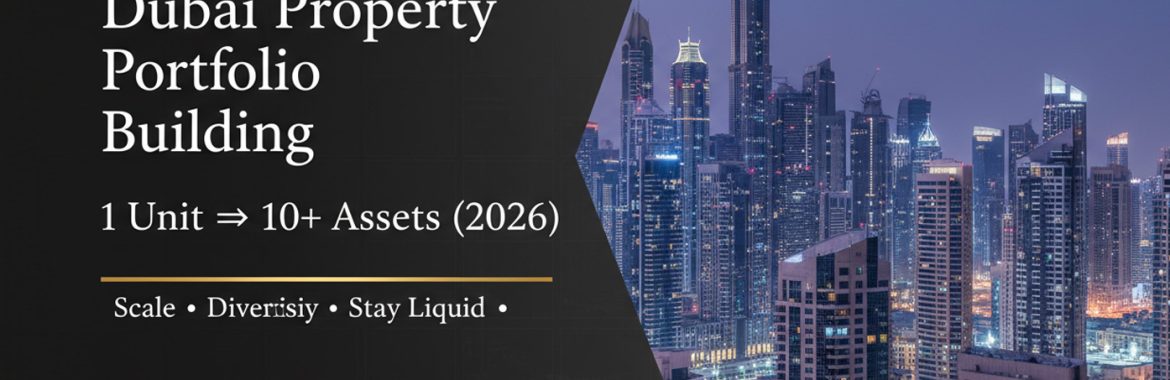
Dubai Property Portfolio Building: How Investors Scale From 1 Unit to 10+ Assets (2026)

Buying a single property in Dubai is relatively easy.
Scaling a profitable, resilient property portfolio in Dubai is something very few investors actually do well.
Between 2026 and the years ahead, Dubai will continue attracting global capital — but the investors who truly outperform will not be those chasing isolated deals. They will be the ones building structured portfolios designed for cash flow, appreciation, liquidity, and optionality.
This guide explains how serious investors scale from one property to ten or more in Dubai — not through speculation, but through planning, sequencing, and disciplined execution.
For market context, explore:
Why Portfolio Thinking Matters More Than Ever in Dubai
Dubai is no longer a one-cycle, one-exit market.
It is a layered, multi-segment ecosystem where:
- Different communities peak at different times
- Rental and resale behave differently across asset types
- Off-plan, ready, and luxury assets follow distinct cycles
Investors who operate deal-by-deal often become overexposed to one segment, one developer, or one timing assumption.
Portfolio investors spread risk — and opportunity — across:
- Locations
- Holding periods
- Tenant profiles
- Exit scenarios
Stage One: The First Property Sets the Direction
Your first Dubai property defines more than returns — it defines your future flexibility.
Experienced portfolio builders prioritise their first acquisition based on:
- High liquidity
- Broad tenant demand
- Strong resale depth
This allows capital to be recycled later.
Common first-asset strategies include:
- Mid-priced apartments in proven communities
- Units with neutral layouts and service charges
- Areas attractive to both tenants and future buyers
Many investors begin with guidance from:
Stage Two: Using Cash Flow to Fund Expansion
After the first acquisition stabilises, portfolio investors focus on cash flow efficiency.
Rental income becomes a strategic tool — not just passive income.
Smart investors use rental yield to:
- Offset holding costs
- Build reserve capital
- Support additional down payments
This stage often involves:
- Targeting high-demand rental corridors
- Optimising furnishing strategies
- Controlling service charge exposure
Relevant insight:
Stage Three: Strategic Use of Off-Plan for Growth
Off-plan property plays a critical role in portfolio scaling — when used correctly.
Portfolio investors use off-plan to:
- Enter early pricing windows
- Stage capital over time
- Capture appreciation during construction
However, off-plan is rarely used as a standalone strategy.
Instead, it complements ready assets by adding growth exposure while existing properties stabilise.
Structured learning includes:
Stage Four: Diversifying Across Asset Types
As portfolios grow beyond three to five properties, diversification becomes essential.
Advanced investors avoid concentrating entirely in:
- One community
- One developer
- One tenant profile
Diversification may include:
- Mixing apartments with townhouses or villas
- Combining rental-focused and appreciation-focused assets
- Introducing limited luxury exposure
This is where advisory-led planning becomes critical.
Many investors work with:
Risk Management in Multi-Property Portfolios
Scaling increases exposure — but it should not increase fragility.
Professional investors manage risk by monitoring:
- Aggregate service charge exposure
- Tenant concentration risk
- Resale liquidity across assets
- Developer delivery history
Portfolios fail not because of one bad asset — but because of unchecked concentration.
Exit Planning at the Portfolio Level
Scaling is not just about buying more.
It is about maintaining flexibility.
Portfolio investors plan exits by:
- Staggering asset maturities
- Rotating capital from mature assets into early-cycle ones
- Avoiding synchronized exits across multiple units
This ensures liquidity without forcing sales.
International Investors and Cross-Border Portfolios
Dubai attracts global investors building portfolios remotely.
Successful international portfolio builders prioritise:
- Clear legal ownership structures
- Professional property management
- Advisors who understand cross-border execution
Country-specific guidance:
FAQs – Frequently Asked Questions
How many properties make a portfolio?
A portfolio begins when assets are planned collectively rather than individually.
Is leverage necessary to scale in Dubai?
Not always. Many investors scale through staged payment plans and capital recycling.
Does scaling increase risk?
Only if diversification and exit planning are ignored.
Wrapping Up
Dubai rewards investors who think in systems, not transactions.
Scaling from one property to ten is not about speed — it is about sequencing, balance, and discipline.
Portfolios outperform deals because portfolios are designed.
If your goal is to scale in Dubai, guidance matters.
Work with advisors who understand how assets interact — not just how they sell.
Scale with intent — and let structure do the heavy lifting.