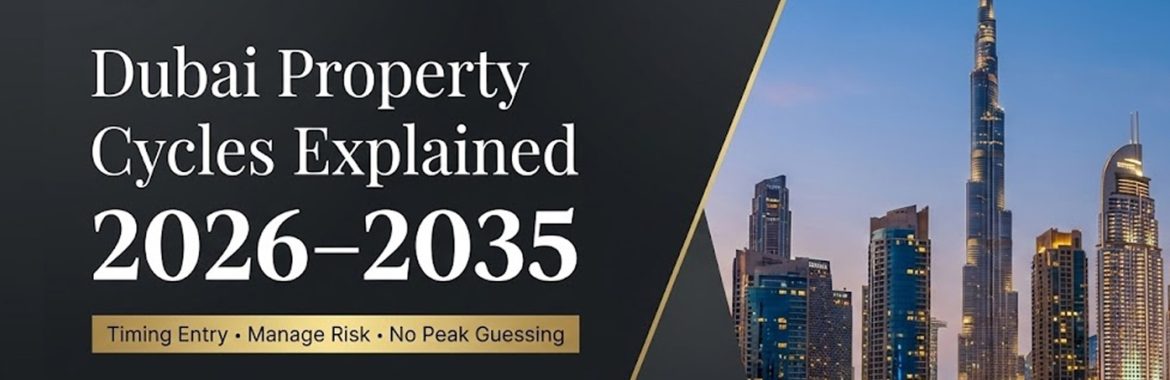
Dubai Property Cycles Explained (2026–2035): How Smart Investors Time Entry Without Guessing Peaks

This is a forward-looking, investor-grade pillar guide for buyers and investors researching Dubai property cycles — written to explain how Dubai’s real estate market actually moves in phases, why most buyers misunderstand timing, and how disciplined investors structure entry decisions without trying to predict tops or bottoms.
Dubai is often described as a “fast-moving” property market.
That description is not wrong — but it is incomplete.
Dubai real estate does not move randomly, and it does not reward emotional timing. It moves in cycles shaped by supply discipline, capital flows, infrastructure delivery, and developer behaviour.
Investors who succeed long term do not attempt to guess peaks. They learn how cycles work, where they are positioned, and how to enter with margin of safety.
This guide explains how Dubai property cycles actually function — and how informed investors approach the 2026–2035 decade with structure rather than speculation.
1) Dubai Property Cycles Are Not the Same as Western Market Cycles
One of the most common mistakes international buyers make is assuming Dubai behaves like London, New York, or Sydney.
It does not.
Dubai’s real estate market is shaped by:
- Master-planned development rather than organic sprawl
- Off-plan construction dominating new supply
- Developer-controlled release schedules
- Global capital flows rather than domestic mortgages alone
This structure creates shorter, sharper cycles — but also clearer entry windows for buyers who understand them.
For context on how this ecosystem works, start with:
2) The Four Phases of a Typical Dubai Property Cycle
While no two cycles are identical, Dubai real estate generally moves through four recognisable phases:
Phase 1: Capital Repositioning
This phase begins quietly. Global investors, regional buyers, and institutions start reallocating capital into Dubai due to macro shifts such as taxation changes, geopolitical stability, or currency dynamics.
Prices are stable, sentiment is cautious, and media attention is limited.
Phase 2: Launch Momentum
Developers respond to rising demand by releasing new off-plan projects. Early buyers benefit from launch pricing, flexible payment plans, and the widest unit selection.
This is where informed investors typically enter.
Phase 3: Acceleration & Public Participation
Transaction volumes rise. Prices move faster. Media coverage increases. Late adopters enter the market, often driven by fear of missing out.
Risk increases — not because Dubai becomes weak, but because entry discipline declines.
Phase 4: Absorption & Normalisation
Supply catches up. Pricing stabilises. The market digests inventory. Strong assets hold value; weaker projects stagnate.
This phase sets the foundation for the next cycle.
3) Where Dubai Appears Positioned Heading Into 2026
As Dubai enters 2026, the market shows characteristics of selective acceleration, not broad overheating.
Key indicators include:
- Measured supply releases rather than uncontrolled expansion
- High absorption in master-planned communities
- Strong end-user demand alongside investor participation
- Capital inflows driven by long-term relocation, not speculation
This distinction matters.
Dubai is not moving as one market — it is moving as a collection of micro-cycles across communities, property types, and price segments.
Understanding this difference is critical when evaluating new launches such as master-planned villa communities, branded residences, and waterfront developments.
4) Why Smart Investors Do Not Try to “Time the Peak”
Attempting to sell at the absolute top or buy at the absolute bottom is a losing strategy in Dubai.
Professional investors focus instead on:
- Entry pricing relative to future supply
- Payment structure efficiency
- Tenant demand depth
- Exit liquidity across multiple buyer profiles
This is why many disciplined investors enter during early launch phases of fundamentally strong projects rather than waiting for media confirmation.
Examples of projects typically evaluated through this lens include early-stage launches in emerging master communities and branded developments with global resale appeal.
5) Off-Plan Cycles: The Engine Behind Dubai’s Market Movements
Off-plan development is not a side feature of Dubai real estate — it is the engine.
Off-plan cycles influence:
- Pricing momentum
- Investor sentiment
- Future resale inventory
Experienced investors assess off-plan opportunities by examining:
- Developer delivery track record
- Escrow and milestone realism
- Expected rental demand at handover
- Service charge sustainability
Structured reading:
6) Micro-Cycles Matter More Than Headlines
Dubai does not move as a single price chart.
Luxury waterfront residences, suburban family communities, and mid-market apartments often move on completely different timelines.
For example:
- End-user villa communities absorb supply steadily
- Branded residences respond strongly to international demand cycles
- Investor-heavy districts fluctuate based on yield compression
This is why informed buyers focus on micro-market timing rather than citywide predictions.
7) How Investors Use Payment Plans to Manage Cycle Risk
Dubai’s payment plans allow investors to participate in growth phases while staging capital exposure.
Rather than deploying full capital upfront, buyers align payments with:
- Construction progress
- Rental income timelines
- Portfolio diversification strategies
Understanding payment structure is essential:
8) The 2026–2035 Outlook: What Long-Term Investors Are Watching
Long-term investors evaluating Dubai’s next decade focus on durability, not hype.
Key drivers shaping future cycles include:
- Population growth driven by skilled migration
- Infrastructure expansion and master community delivery
- Dubai’s positioning as a global wealth and business hub
- Regulatory consistency for foreign ownership
Rather than asking “Is now the top?”, disciplined investors ask:
“Does this asset still make sense if I hold it through multiple phases?”
Final Thought: Timing Dubai Real Estate Is About Structure, Not Prediction
Dubai property cycles reward buyers who understand how the market works — not those who chase headlines.
Smart investors do not try to outguess the cycle. They position themselves within it.
By focusing on asset quality, entry discipline, and exit flexibility, Dubai real estate becomes less about timing luck — and more about repeatable strategy.
Strategic Call to Action
If you are evaluating opportunities in Dubai for 2026 and beyond, the most valuable step is not predicting where prices will peak — it is structuring your entry with clarity and discipline.
Explore deeper strategic guidance:
The right framework protects your downside — and positions you for long-term upside.